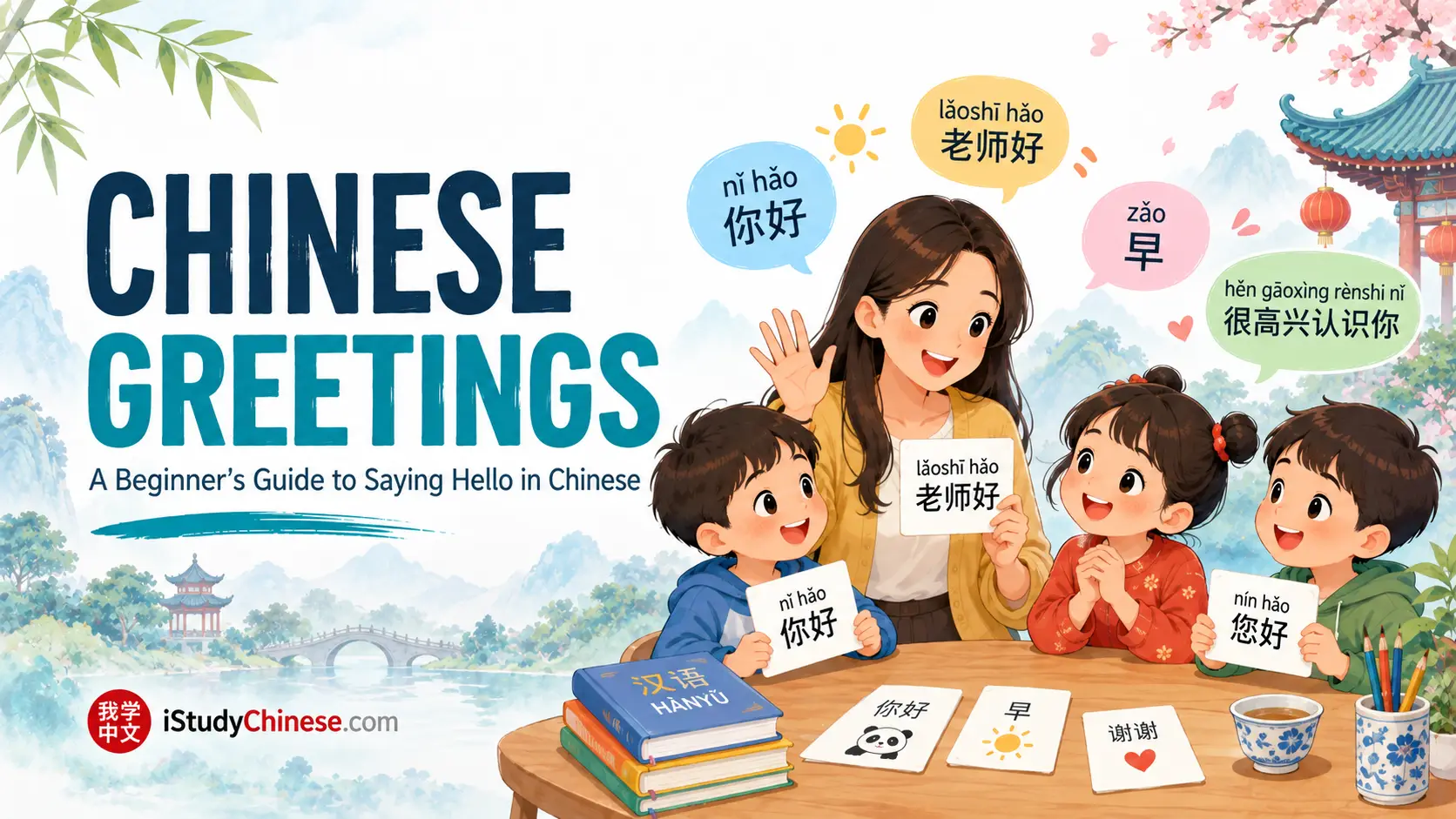

Chinese greetings range from classic textbook phrases to how ordinary people talk to each other day-to-day.
Here’s how to greet people in different situations:
1. The Classics (The Ones Everyone Learns First)
Nǐ hǎo (你好) = Hello
- Literally: “You good.”
- When to use: Safe for meeting new people or people you’re unfamiliar with, but sounds too formal or distant to use with friends (see Everyday Informal Greetings below).
Nín hǎo (您好) = Hello (Respectful)
- When to use: Use this when addressing elders, teachers, bosses, or customers. Changing nǐ to nín instantly shows politeness and respect.
Colloquial Chinese can be very context dependent, so a greeting in one scenario can seem out of place in another.
So using Nǐ hǎo with close friends can feel weird and unnatural, as it’s a bit like saying “Good day to you” or “How do you do?”
It’s best used between people who’ve just met or aren’t very familiar with each other. Nǐ hǎo shows you’re polite and friendly.
If you say “Nǐ hǎo” to someone you’ve met several times and/or already spoken to awhile, they might feel like you don’t regard them as a friend.
I have read, though, that some friends say it to each other if they’ve been reunited after years apart.
2. Professions and Titles
For teachers you’re familiar with, you can say:
“Lǎo shī hǎo!” (老师好) = Hello teacher!
In fact, this [Title/Noun] + hǎo (好) structure is a respectful, safe, and polite way to address someone in various professional and social settings in China.
Here are some other examples:
- “Jīng lǐ hǎo” (经理好) = Hello, Manager
- “Yīshēng hǎo” (医生好) = Hello, Doctor
- “Yéye hǎo” (爷爷好) = Hello, Grandfather
When addressing a single specific person in a formal setting, it’s even more natural to insert their Surname before the title. So using the structure [Surname] + [Title] + hǎo as a greeting:
- Wáng lǎoshī hǎo (王老师好) – Hello, Teacher Wang
- Lǐ jīnglǐ hǎo (李经理好) – Hello, Manager Li
- Zhāng yīshēng hǎo (张医生好) – Hello, Doctor Zhang
You can swap out different professions and titles as you learn them.
3. Everyday Informal Greetings (What Native Speakers Say)
Many native speakers use these much more casual options:
“”Hālóu” / “Hāi” / “Hēi” (哈喽 / 嗨 / 嘿) = Hello / Hi / Hey
- Borrowed straight from English, this is extremely popular among young people and on social media.
- Normally used when speaking to friends or people your own age.
Just use their nickname
If you’re familiar with the person, be it friend or family, then just greet them with their nickname and maybe a nod if you like.
- Māma (妈妈 – Mom)
- Gēge (哥哥 – Elder brother)
- Xiao Lǐ (小李 – Little Li)
- Wáng Bóbo (王伯伯 – Uncle (Father’s elder brother) Wang)
I’ll cover family members in a later post.
“(Nǐ) chī le ma?” ((你)吃了吗?) = Have you eaten?
- Literally: “Have you eaten [yet]?”
- How it works: This is the iconic Chinese equivalent of asking “How’s it going?” or “What’s up?”. It stems from a culture that values food and care. Tends to be used by older generations.
- How to answer: You don’t need to describe your meal! Just say “Chī le, nǐ ne?” (吃了,你呢? – Eaten, and you?), or “Hái méi yǒu” (还没有 – Still haven’t), or “Méi yǒu, nǐ ne?” (没有, 你呢? – Haven’t, you?).
“Chī le ma?” is used with people you’re already familiar with. Not strangers or people you’ve only met a few times. There’s no expectation for you to offer food afterwards either!
4. Standard Time-Based Greetings
These are pretty standard and are fine in formal situations, but less commonly used casually.
| Pinyin | Characters | English | Usage |
| Zǎoshang hǎo | 早上好 | Good morning | Standard / slightly formal morning greeting |
| Xiàwǔ hǎo | 下午好 | Good afternoon | Standard afternoon greeting |
| Wǎnshang hǎo | 晚上好 | Good evening | Standard evening greeting |
| Wǎn’ān | 晚安 | Good night | Used strictly when going to sleep or parting late at night |
Everyday Alternatives
“Zǎo” (早) – Morning!
- While “Good morning” is Zǎoshang hǎo (早上好), people colloquially tend to say “Zǎo!” as they walk past coworkers or classmates. This is a bit like “Morning!” for English speakers.
Sometimes people ask an obvious question as a greeting. Maybe you run into a coworker after lunch. You could say:
- “Chī wán la?” (吃完啦? = Finished eating?)
- “Hái méi chī nǎ?” (还没吃哪? = Still haven’t eaten?)
If you see a neighbor after work, you might say:
- “Huí lái la?” (回来啦?) = You’re back?
Maybe you bump into an old friend:
- “Jiàndào nǐ zhēn hǎo” (见到你真好) = It’s really good to see you.”
- “Hǎo jiǔ bú jiàn!” (好久不见!) = “Long time no see!”
Or just run into any friend on the street:
- “Gàn shá qù ya?” (干啥去呀?) = “What are you up to?”
- “Qù nǎr?” (去哪儿?) = Where are you going?
Common beginner misconception: For some reason, beginners are often taught “Nǐ hǎo ma?” (你好吗?) to mean “How are you?”
This does indeed mean “How are you?”, but more as if asking out of concern for someone’s wellbeing or health. It’s not used like “How ya doing?”, so not recommended for use as a greeting! Say it if you see someone fall over, or to someone who’s recovering from illness.
5. Nice to Meet You!
“Hěn gāoxìng rènshi nǐ” (很高兴认识你)
This is the standard, Chinese equivalent of “Nice to meet you” or “Pleased to meet you.”
It’s polite and friendly without sounding overly casual (like Hāi!) or stiffly formal (like Xìnghuì!).
Breakdown of the Phrase
- Hěn (很) = Very / Very much
- Gāoxìng (高兴) = Happy / Glad
- Rènshi (认识) = To know / To recognize / To meet (someone)
- Nǐ (你) = You
Note: As in English, you would only use this when meeting someone for the very first time. (You wouldn’t say it to someone you already know!).
It works in almost any situation where you are introduced to a peer, a friend’s friend, a new classmate, or a new coworker.
Common Variations & Native Conversational Flow
1. How to respond when someone says it to you
If someone says “Hěn gāoxìng rènshi nǐ,” the most natural response is to put Yě (也 = also) before hěn:
- “Wǒ yě hěn gāoxìng rènshi nǐ!” (我也很高兴认识你!= Nice to meet you, too! / I’m also very happy to meet you!)
2. Making it formal (for bosses, elders, clients)
Swap nǐ (你) for the respectful nín (您):
- “Hěn gāoxìng rènshi nín.” (很高兴认识您。)
3. Greeting a group of new people
Swap nǐ (你) for dàjiā (大家) or nǐmen (你们):
- “Hěn gāoxìng rènshi nǐmen!”
(很高兴认识你们!= Nice to meet you all!) - “Hěn gāoxìng rènshi dàjiā!”
(很高兴认识大家!= Nice to meet everyone!)
Typical Standard First-Meeting Dialogue
Here’s how a first-time introduction might sound:
- Person A: Nǐ hǎo! Wǒ shì David. (你好!我是 David。) — Hi! I am David.
- Person B: Nǐ hǎo! Wǒ shì Lǐ Huá. Hěn gāoxìng rènshi nǐ! (你好!我是李华。很高兴认识你!) — Hi! I am Li Hua. Nice to meet you!
- Person A: Wǒ yě hěn gāoxìng rènshi nǐ! (我也很高兴认识你!) — Nice to meet you too!
Make It Super Formal
To get even more respectful and formal, you could even say:
- Xìnghuì (幸会) = Nice to meet you / Pleased to meet you.
However, this is not a casual everyday greeting. It is an elevated, formal phrase that carries a traditional, polite vibe – not really one you’d hear very often.
I would be tempted to say it jokingly or playfully with friends, but it’s not something you’d use much.
What does it literally mean?
The literal translation gives away why it sounds so formal:
- Xìng (幸) = Fortunate / Lucky
- Huì (会) = To meet / To assemble
So when you say Xìnghuì, you are literally saying: “It is my good fortune to meet you.”
How and When to Use It
Because it is so polite, you might hear it in specific, formal contexts:
- Business & Professional Settings: Meeting a new client, partner, or executive for the first time.
- Meeting Someone Famous or Respected: Meeting a professor, an author, or an industry leader you admire.
- Period Dramas & Movies: Characters in Chinese historical dramas or martial arts films use this constantly!
The Classic Set Phrase
Native speakers almost always double it up when meeting someone formally:
- “Xìnghuì, xìnghuì!” (幸会,幸会!)
- (Pleased to meet you! / So wonderful to meet you!)
I’m not sure, but you might get some funny looks, as this is so formal!
Summary of “Nice to meet you” Options
To see where Xìnghuì fits compared to other ways of saying “Nice to meet you”:
| Chinese | Pinyin | Level of Formality | Best Used For |
| Xìnghuì! | 幸会 | Very Formal | Business meetings, VIPs, or professional introductions. |
| Hěn gāoxìng rènshi nǐ | 很高兴认识你 | Standard / Polite | The everyday “Nice to meet you” (used when making new friends or meeting colleagues). |
| Hāi! | 嗨 | Casual | Meeting peers, classmates, or friends of friends. |
Rule of Thumb: If you are meeting a new peer at a coffee shop or a social event, stick to “Hěn gāoxìng rènshi nǐ” (很高兴认识你). Save “Xìnghuì” for suit-and-tie events or when you really want to make a respectful first impression!
6. Talking to More Than One Person
- “Dàjiā hǎo” (大家好)
This is a great phrase for greeting a group of people. It’s the universal, go-to Chinese equivalent of saying “Hello, everyone!” or “Hi, everybody!”
Breakdown of the Phrase
- Dàjiā (大家) = Everyone / Everybody (Literally: “Big family”)
- Hǎo (好) = Good / Hello
Why it’s useful
It strikes the perfect balance: it is polite, friendly, and naturally fits many scenarios – from casual gatherings to formal presentations.
Here’s where you’ll hear and use it most:
- Vlogs & Social Media: Almost every content creator on YouTube, Bilibili, or Xiaohongshu opens their video with:“Dàjiā hǎo, wǒ shì…” (大家好,我是…)(Hello everyone, I am…)
- Group Chats (WeChat): Dropping a “Dàjiā hǎo!” when you join a new group chat is standard, friendly etiquette.
- Presentations & Meetings: Before starting a speech, business presentation, or class, this is the standard opening greeting.
Adding Tone Particles for Extra Friendliness
Just like with Nǐ hǎo, you can add sentence-ending particles to Dàjiā hǎo in casual settings to soften it up:
- “Dàjiā hǎo a!” (大家好啊!) = Hi everyone!
(Sounds warm and lively)
Other Ways to Greet Groups
Depending on who is in the group, here are two quick variations:
- “Nǐmen hǎo!” (你们好!) = Hello!
(Used when speaking to more than one person)
(Slightly more casual, best for small groups of 2–4 peers).
- “Gèwèi hǎo!” (各位好!) = Hello everyone!
(Slightly more formal/professional than dàjiā hǎo, great for business meetings or public announcements).
If you are ever speaking to more than one person at a time, “Dàjiā hǎo!” is fine.
7. Cultural Body Language Trick
In modern China, people shake hands in business or nod/wave casually with friends. No bowing or putting your hands together as though to pray; I’ve read some foreigners mistakenly do this when greeting Chinese people.
During grand traditional festivals (like Chinese New Year) or formal traditional greetings, you might see the Gǒngshǒu (拱手) or “fist-and-palm” salute, where you wrap one hand over your other fist at chest level as a sign of respect and blessing.
This isn’t something you’d see in everyday greetings, though.
8. Voice and Video Calls
- “Wéi” (喂) = Hello?
Used almost exclusively to answer phone calls.
Summary
So there you have it; if you bumped into a Chinese friend on the street are introduced to someone new, or are just answering the phone, you now know exactly what to say.