Let’s look at some practical, day-one conversational building blocks.
Instead of learning a huge list of random words, I think what seems to be one of the best ways to start learning any language, Chinese included, is to look at high-frequency structural verbs – words that allow you to build dozens of different sentences straight away.
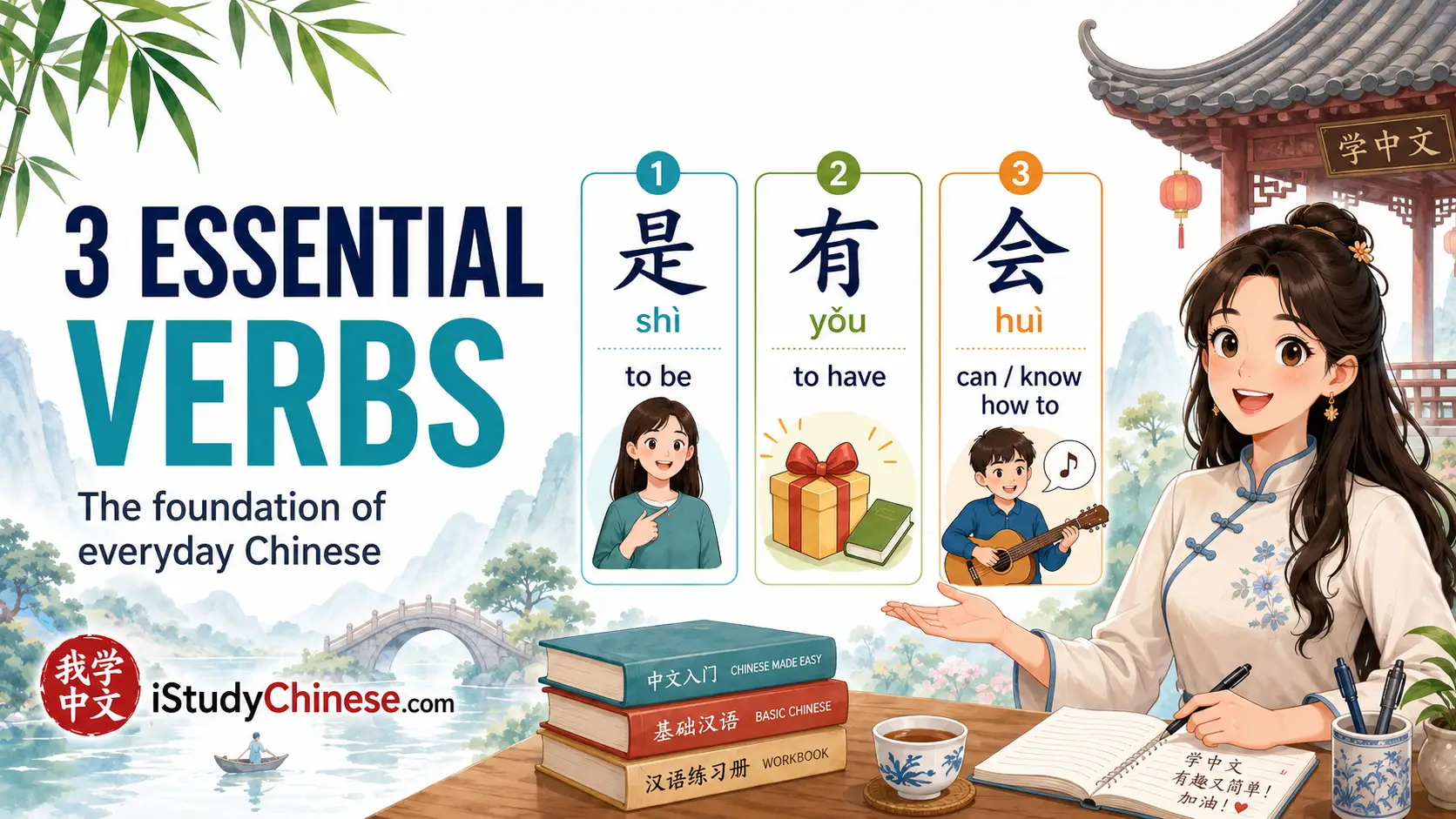
So let’s look at three essential verbs you really do need to know, how they differ, and how to use them naturally.
Quick Vocabulary
Pronouns:
我 (tǒ) – I, me
你 (nǐ) – You
他 (tā) – He, him
她 (tā) – She, her
它 (tā) – It
Others:
学生 (xuéshēng) – student
老师 (lǎoshī) – teacher
车 (chē) – car
这 (zhè) – this
1. 是 (Shì) – “To Be” (Am / Is / Are)
Unlike English and many other languages, shì never changes its form based on who’s speaking (no conjugation!). It connects a subject directly to a noun.
Important Grammar Note: Never use shì to connect a subject to an adjective. (e.g., Don’t say “I am happy” using shì). Only use it to link nouns.
我是(your name)。 (Wǒ shì (your name).) I am (your name).
我是学生。 (Wǒ shì xuéshēng.) I am a student.
他是你的老师吗? (Tā shì nǐ de lǎoshī ma?) Is he your teacher?
这不是我的车。 (Zhè bú shì wǒ de chē.) This is not my car.
Pronunciation note: “Bù” is usually pronounced with a downward, falling tone, but notice in this case “bù” changes to “bú” (upward, rising tone) before another 4th-tone word!
2. 有 (Yǒu) – “To Have” or “There Is”
This is used to show possession (“I have a guitar”) or to state that something exists somewhere (“There is a coffee shop here”).
Important Grammar Note: You never use “不” (bù) to negate “有” (yǒu). To say “don’t have,” you must use 没 (méi). So that’s 没有 (méi yǒu).
我有一辆车。 (Wǒ yǒu yī liàng chē.) I have a car. (liàng is the counter word for vehicles.)
我没有苹果。 (Wǒ méi yǒu píngguǒ.) I don’t have an apple.
这里没有人。 (Zhè lǐ méi yǒu rén.) There is nobody here. (Literally: Here doesn’t have people.)
3. 会 (Huì) – “Can” (Acquired Skills)
In HSK1, we’re introduced to a few words that mean “can” (I’ll look at these in a later post), but huì specifically means to know how to do something because you learned or practiced it (like speaking a language, cooking, or playing an instrument).
我会说汉语。 (Wǒ huì shuō Hànyǔ.) I can speak Chinese.
他不会做饭。 (Tā bú huì zuòfàn.) He cannot cook.
你会开车吗? (Nǐ huì kāichē ma?) Can you drive a car?
There’s also a sentence structure that means “Does someone [verb] or not?” or “Are you [verbing]?”. I’ll look at this sentence structure in more detail in a separate post, but for this post:
你会不会弹吉他? (Nǐ huì bú huì tán jítā?) Can you (or not) play guitar?
Let’s Put It Together
Look at how you can put all of this together to introduce yourself in Chinese:
我是学生, 我有一个中文老师, 我会说一点儿汉语。 Wǒ shì xuéshēng, wǒ yǒu yī gè Zhōngwén lǎoshī, wǒ huì shuō yīdiǎnr Hànyǔ.” I am a student, I have a Chinese teacher, I can speak a little Chinese.
Pronunciation Note: The term 一点儿 (yīdiǎnr) means “a little”. As a beginner, you might think “How do I say that?!” It doesn’t follow how we say things in English.
All you have to do, really, is remove the “n” from diǎn and the whole thing sounds more like “yīdiǎr“.
Also note that yīdiǎnr is more common in the North, and yīdiǎn (without the “r”) is more common in the South
Now, as your vocabulary builds out, you can then make more sentences using these very useful verbs.
Summary
So now you can say “I am…”, “I have…”, “You are…”, “You can…”, “She is…”, “He has…”, etc.
With these few verbs, you can make many simple sentences, and after learning a bit more vocabulary, you’ll be able to convey a lot of information when talking in Mandarin.
Keep learning new words and add them to these “I am..”, “He can…” sentences, and you’ll get the hang of it in no time!